
Could a single mature oak tree be the hidden culprit behind your sticking doors and cracked drywall? While we value the shade and curb appeal our local heritage trees provide, the relationship between thirsty roots and Austin’s expansive clay soil is often a recipe for structural disaster. Investing in professional root barrier installation austin residents rely on isn’t just about blocking growth. It’s about creating a moisture-stabilization system that keeps your slab level while respecting the health of your landscape.
It’s natural to feel anxious when you’re caught between the cost of foundation repair and the fear of losing a decades-old tree. You shouldn’t have to sacrifice one for the other. This guide explains how to use high-density polyethylene (HDPE) barriers to manage soil moisture and root direction effectively. We’ll walk through the 2026 City of Austin tree ordinances, the importance of protecting the Critical Root Zone, and how to implement a long-term solution that prevents the need for house leveling.
Key Takeaways
- Learn how vertical moisture-proof shields redirect root growth to prevent the localized drying that causes Austin foundations to settle unevenly.
- Understand the 36-inch depth standard required for effective root barrier installation austin residents use to combat the region’s unique Blackland Prairie clay.
- Compare professional materials like HDPE rolls and Biobarriers to choose the most durable underground defense for your home’s landscape.
- Discover the essential steps of the professional installation process, including utility locating and strategic trench excavation to protect your property’s infrastructure.
- Explore why root barriers are most effective when integrated into a total house leveling strategy for long-term structural restoration.
Why Root Barrier Installation is Vital for Austin Foundations
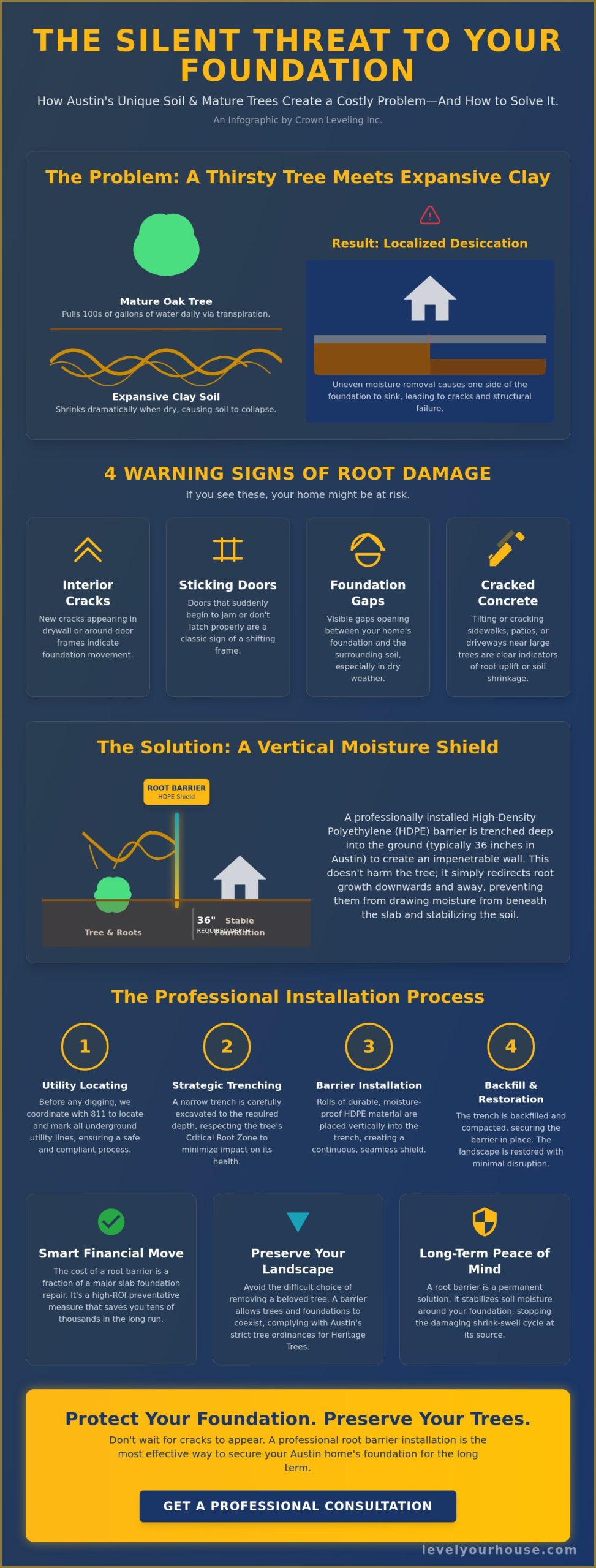
When Austin homeowners think about foundation safety, they usually look at drainage or plumbing leaks. However, the most persistent threat often comes from the very trees that provide shade and character to the property. Understanding What is a Root Barrier? is the first step toward long-term protection. Essentially, a root barrier is a vertical, moisture-proof shield installed deep underground. Its primary purpose is to redirect root growth away from your home’s footprint, preventing the catastrophic soil movement that leads to structural failure. For many, professional root barrier installation austin is the most effective way to balance a love for landscaping with the need for a stable home.
The conflict in Central Texas is unique. Austin sits on expansive clay soil that acts like a sponge. It swells when wet and shrinks aggressively when dry. When a large tree is planted too close to a slab, it doesn’t just push against the concrete. It sucks the moisture out of the clay. This creates localized “dry pockets” that cause the soil to collapse, leading to uneven settling. You might notice your home needs a barrier if you see these red flags:
- Large gaps appearing between your foundation and the soil during dry spells.
- Sidewalks or patio slabs that are tilting or cracking near a tree.
- New cracks in your interior drywall or sticking doors.
Investing in a barrier offers a significant return on investment. The cost of preventative installation is a fraction of the price of a major slab foundation repair. By acting early, you stop the cycle of soil desiccation before the slab begins to sink.
The Role of Mature Trees in Foundation Failure
Large root systems can grow up to three times the width of the tree’s canopy. Through a process called transpiration, a single mature oak can pull hundreds of gallons of water from the ground every day. During Austin’s notoriously hot, dry summers, this water consumption accelerates. As the tree pulls water from beneath your slab, the clay soil shrinks, leaving your foundation unsupported. This isn’t just a seasonal issue; it’s a structural hazard that worsens every year the tree grows.
Root Barriers vs. Tree Removal: The Austin Perspective
Many homeowners fear they must choose between their trees and their home. In Austin, tree removal is often complicated by strict local ordinances. As of 2026, the City of Austin regulates any tree with a diameter of 8 inches or greater, while “Heritage Trees” like Texas Ash or American Elm are protected once they reach 24 inches. A professional root barrier installation austin allows you to comply with these environmental protections while keeping your foundation safe. It creates a boundary where trees and concrete can coexist without one destroying the other.
The Science: How Austin’s Clay Soil and Roots Interact
Austin sits atop a geological challenge known as Blackland Prairie clay. This soil is famous for its high montmorillonite content, which causes it to expand and contract dramatically based on moisture levels. During a typical Texas wet season, the clay swells and exerts upward pressure on your home. When the intense heat of 2026 sets in, the soil loses water and shrinks. This creates a volatile environment for any concrete slab. Professional root barrier installation austin services address this by preventing roots from accelerating the drying process in specific, high-risk zones.
Roots cause a phenomenon called localized desiccation. As a tree transpires, it doesn’t pull moisture evenly from the entire yard. Instead, it creates dry pockets directly beneath or adjacent to the foundation. This uneven drying causes one part of the foundation to drop while another remains stable. It’s this differential settlement, rather than uniform movement, that snaps slabs and cracks masonry. Managing these moisture gradients is the scientific core of effective root barrier design.
The weather patterns of 2026 have made this management even more critical. With Texas experiencing more frequent and severe swings between drought and heavy rainfall, the “shrink-swell” cycle is moving faster than in previous decades. This rapid movement puts immense stress on older slabs that weren’t designed for such extreme soil volatility. If you suspect your trees are encroaching on your home’s footprint, consulting with a foundation specialist can help identify these hidden risks before they become structural emergencies.
Expansive Clay and the Foundation ‘Void’ Problem
When clay soil shrinks, it often pulls away from the bottom of a concrete slab. This leaves a hollow space, or a “void,” where the foundation is no longer supported by the earth. Roots are opportunistic. They exploit these voids because the soil under a house is often cooler and retains moisture longer than the exposed yard. Once roots establish themselves in these gaps, they continue to pull water, widening the void and making the foundation even more unstable. This perimeter settling is often a tree problem disguised as a simple soil issue. Understanding the common myths about expansive clay soil foundation damage can help homeowners recognize these warning signs before they escalate into costly repairs.
Hydrotropism: Why Roots Seek Your Foundation
Roots possess a biological drive called hydrotropism, which is the tendency to grow toward moisture. Your foundation often acts as a giant umbrella, trapping water in the soil beneath it. Even worse, tiny, undetected leaks in under-slab plumbing act as a beacon for invasive root systems. Roots can wrap around or even penetrate pipes to reach the water source. This often leads to a cycle of damage where foundation tunneling for plumbing becomes necessary to repair the broken lines and the foundation simultaneously.
Comparing Root Barrier Methods: Materials and Depth
Selecting the right material and depth for root barrier installation austin projects depends on the tree species and its proximity to your home’s footprint. Depth is the most critical factor in Central Texas. While most feeder roots reside in the top 24 inches of soil, Austin’s Blackland Prairie clay can develop deep fissures during extreme droughts. These cracks provide a highway for roots to dive much deeper than usual. For this reason, a 36 inch vertical shield is the industry standard for effective protection. In cases involving massive heritage oaks or homes built on sloped lots, a “Deep Root” system extending 48 inches or more may be necessary to ensure roots don’t simply dive under the barrier.
Effective root management doesn’t exist in a vacuum. To truly protect a foundation, the barrier must integrate with your overall maintenance strategy. This includes foundation watering systems and proper yard drainage. A physical barrier acts as a moisture dam. It helps keep the soil under your slab at a consistent moisture level while allowing you to water your trees safely on the other side. By separating these two zones, you prevent the tree from competing with your foundation for the same water source during a July heatwave. Understanding how to water your foundation in Texas correctly ensures that the moisture envelope around your slab remains stable even as thirsty roots draw from the surrounding soil.
Physical Barriers (HDPE Liners)
High-Density Polyethylene (HDPE) liners are the most common choice for 2026 foundation protection. To stop aggressive Texas roots, a thickness of 30-mil to 60-mil is required. Thinner materials risk being punctured by woody growth over time. Professional-grade HDPE panels often feature vertical ribs. These ribs are essential because they redirect roots straight down toward deeper soil rather than allowing them to grow sideways along the barrier. This downward redirection ensures the tree remains stable while your slab stays isolated from moisture-sucking growth.
Chemical and Hybrid Barriers
Biobarriers represent a different approach by using a time-release herbicide called Trifluralin. These systems consist of a geotextile fabric with small nodules that create a “no-growth” zone around the barrier. While these are effective at stopping root tips without damaging the rest of the tree, their longevity in Central Texas is a consideration. In the intense heat and alkaline soil of Austin, the chemical effectiveness typically lasts about 15 to 20 years. For homeowners seeking a permanent, “once and done” solution, a physical HDPE liner is often the more reliable long-term investment. However, Biobarriers are excellent for tight spaces where a rigid liner might be difficult to install around existing utilities.
How to Install a Root Barrier: The Professional Process
Executing a successful root barrier installation austin project requires more than just digging a hole. It’s a calculated technical process that begins with a call to 811 for utility locating. In Austin’s older neighborhoods, gas lines and water mains are often buried exactly where a barrier needs to go. Cutting a line doesn’t just stop the project; it creates a safety hazard. Once the site is cleared, professional teams evaluate the required depth. To choose the right depth in 2026, use this framework: if the tree is an Austin Heritage species with a diameter over 24 inches, or if your clay soil shows fissures wider than two inches, you should bypass the 36-inch standard and opt for a 48-inch deep-root system.
The actual installation follows a strict sequence to ensure the foundation remains isolated from future growth. After trenching, teams perform root pruning. This involves making clean, surgical cuts to roots that are encroaching on the foundation zone. Unlike a shovel or a backhoe, which can tear and shatter root systems, professional pruning tools leave a smooth surface that heals quickly. Once the trench is clear, the High-Density Polyethylene (HDPE) liner is placed. It’s vital that the vertical ribs face the tree to redirect growth downward. The final step is backfilling with the excavated clay and compacting it in layers. Proper compaction is essential to prevent air pockets, which can become conduits for moisture and lead to further soil settling. If you’re concerned about encroaching trees, it’s time to schedule a professional foundation assessment to determine the best path forward.
Precision Excavation Near the Foundation
Digging near a concrete slab requires extreme care. Most professionals use manual digging or specialized narrow trenchers to get within 12 to 24 inches of the foundation without vibrating the concrete. The “Drip Line Rule” is often used to determine the excavation path. This rule suggests that the most active roots are located directly under the outer edge of the tree’s branches. If roots have already grown under the foundation, they must be cut at the barrier line and left to decompose naturally, as pulling them out could leave massive voids that undermine the slab’s support.
Maintaining Tree Health During Installation
Protecting your home shouldn’t mean killing your landscape. The industry follows the 25% rule, which dictates that you should never prune more than a quarter of a tree’s total root system in a single season. Exceeding this limit can starve the tree of nutrients and water, leading to canopy dieback or instability. After the barrier is in place, homeowners should follow a strict watering schedule for the next 12 months to help the tree recover. For protected Heritage Trees, it is highly recommended to consult a certified Austin arborist to oversee the pruning process and ensure compliance with local tree preservation ordinances.
Professional Root Barrier Installation with Crown Leveling Inc.
Crown Leveling Inc. understands that your home’s stability is tied directly to the health of the surrounding soil. Our team possesses deep expertise in the unique “Foundation-Root” ecosystem of Central Texas. We don’t treat root management as a minor landscaping chore. Instead, it’s a vital structural intervention. When you partner with us for root barrier installation austin, you’re working with foundation specialists who recognize exactly how trees, clay, and concrete interact during long Texas droughts.
If your home has already experienced shifting, we often integrate our root barriers into a total house leveling strategy. This approach ensures that we don’t just fix the symptoms of foundation failure but address the root cause as well. By combining structural restoration with a permanent moisture-proof shield, we lock in your home’s elevation. This prevents the aggressive shrink-swell cycle from undermining your slab once the leveling work is complete.
The Crown Leveling Inc. difference is found in our precision and material selection. We utilize high-grade HDPE panels that create an impenetrable vertical dam, specifically chosen for their durability in alkaline Austin soil. Our technicians focus on surgical root pruning and meticulous backfilling to ensure no air pockets remain. We also provide a comprehensive maintenance plan to help you manage foundation watering and drainage long after the installation is finished.
Service Areas Across Central and South Texas
Our specialized teams serve homeowners throughout Austin, Round Rock, and Pflugerville, along with the surrounding Hill Country. We also provide localized solutions for the aggressive clay conditions in San Antonio and New Braunfels. For properties along the coast, we offer customized root barrier installation in Corpus Christi, adapting our methods for sandy soil and salt air environments.
Get Your Free Foundation and Root Assessment
No two yards are exactly alike. The proximity of your trees and the specific composition of your soil require a tailored approach to barrier depth and length. During our on-site inspection, we’ll map out your root zones and identify any structural vulnerabilities. We focus on balancing the health of your landscape with the safety of your home. Schedule your Austin root barrier consultation today!
Secure Your Slab and Preserve Your Landscape
Managing the intersection of mature trees and your home’s footprint is essential for long-term structural health. As we’ve discussed, creating a moisture-stabilization system through professional barrier placement protects your slab from the aggressive drying effects of thirsty root systems. This proactive step prevents the need for expensive repairs while allowing your heritage trees to thrive safely away from your foundation.
A professional root barrier installation austin service provides the peace of mind needed to face the volatile Texas climate. Crown Leveling Inc. specializes in non-invasive protection and has deep expertise in managing the unique challenges of Texas Blackland Prairie clay. Our teams serve Austin, San Antonio, and the surrounding areas, delivering solutions that are both effective and environmentally conscious.
Don’t wait for structural damage to compromise your home’s value. Protect Your Foundation – Get a Free Root Barrier Quote from Crown Leveling Inc. and take control of your property’s future. You don’t have to choose between a stable home and a beautiful landscape; with the right protection, you can have both.
Frequently Asked Questions
Will installing a root barrier kill my mature oak tree?
No, professional installation won’t kill your tree if you follow established pruning standards. Industry professionals limit root cutting to no more than 25% of the total root system. This ensures the tree maintains its structural stability and continues to receive enough water and nutrients. Proper post-installation care, such as deep watering, helps the tree recover quickly from the surgical cuts.
How deep does a root barrier need to be for Austin soil?
Most root barrier installation austin projects require a depth of at least 36 inches. This depth is necessary because Austin’s expansive clay can develop deep fissures during a drought, allowing roots to dive deeper than they would in other soil types. For exceptionally large heritage oaks or steeper slopes, professionals may recommend a 48-inch barrier to prevent the root system from bypassing the shield.
Can I install a root barrier myself?
While a DIY approach is possible, it’s rarely recommended due to the technical risks involved. Excavating deep trenches in Austin’s heavy clay is physically demanding and requires specialized equipment. More importantly, you risk cutting critical utility lines or accidentally damaging enough of the root system to kill the tree. Professional teams use utility locators and surgical pruning tools to ensure the project is safe and effective.
How much does professional root barrier installation cost in Austin?
The total cost for installation depends on the linear footage, the required depth, and the specific soil conditions on your property. While rocky soil may increase labor time, Austin’s clay is generally easier to trench. Factors like the proximity to the foundation and the need for manual digging around existing utilities will also influence the final investment. It’s best to get an on-site evaluation for an accurate estimate tailored to your landscape.
How long does a root barrier system last?
A physical root barrier made from High-Density Polyethylene (HDPE) is designed to be a permanent solution. This material is resistant to soil chemicals and biological decay, meaning it won’t break down over time. Chemical-based systems, like those using herbicide nodules, typically have a lifespan of 15 to 20 years before the chemical effectiveness begins to fade in the intense Central Texas heat.
Do I need a root barrier if I already have a foundation watering system?
Yes, a root barrier is still necessary because it performs a different function than a watering system. While a soaker hose or foundation watering system adds moisture to the clay, a root barrier prevents thirsty trees from aggressively pulling that same moisture out. Using both systems together creates the most stable environment for your slab by isolating the foundation’s soil from the tree’s water demands. Learn the most effective techniques for how to water your foundation in Texas to maximize the benefit of this combined approach during periods of drought.
What is the best time of year to install a root barrier in Texas?
Late fall or early winter is the ideal time for root barrier installation austin homeowners should consider. During these months, most Texas trees are in a dormant or semi-dormant state, which reduces the stress caused by root pruning. The cooler temperatures also help the soil retain moisture, giving the tree a better chance to heal its root system before the extreme heat of the following summer arrives.
Can roots grow through a concrete foundation?
Tree roots generally cannot grow directly through solid, uncracked concrete foundations. However, they are highly opportunistic and will find any existing hairline cracks or plumbing penetrations. Once a root enters a small gap, it can expand as it grows, widening the crack and causing significant structural damage. A barrier prevents this by stopping the roots before they ever reach the slab’s edge.