
Your foundation isn’t failing because of poor construction. It’s failing because of the ground beneath it. In Austin, foundation repair is less about fixing concrete and more about understanding a living, breathing soil that swells with every rainstorm and shrinks dramatically during drought. That’s the geological reality of building on the Blackland Prairie, and most generic repair guides completely miss it.
If you’ve noticed sticking doors, diagonal cracks creeping from your window corners, or floors that no longer feel quite level, you already know something is wrong. What you probably don’t know is why it keeps happening, or why a repair that seemed to work a few years ago is showing signs of trouble again. Those are fair concerns, and they deserve a straight answer.
This guide cuts through the confusion. You’ll learn exactly how Austin’s extreme wet-to-dry cycles drive foundation movement, what separates a lasting repair from a temporary fix, and how to evaluate your options with confidence. From pier types to soil management to protecting your property’s long-term value, everything you need is here.
Key Takeaways
- Austin’s Blackland Prairie clay soil expands and contracts with extreme force through wet-dry cycles — understanding this cycle is the first step to stopping repeat foundation damage.
- Effective foundation repair in Austin depends on matching the right pier system to your soil depth and conditions, not simply choosing the cheapest available option.
- Consistent soil moisture management — especially during Central Texas droughts — is one of the most powerful preventive tools a homeowner has against future foundation movement.
- Knowing which warning signs to look for, both inside and outside your home, lets you catch foundation problems early before minor shifts become costly structural failures.
- Choosing a repair partner with transferable warranties and third-party engineering oversight can protect both your repair investment and your home’s long-term resale value.
Understanding the ‘Austin Shift’: Why Foundations Fail in Central Texas
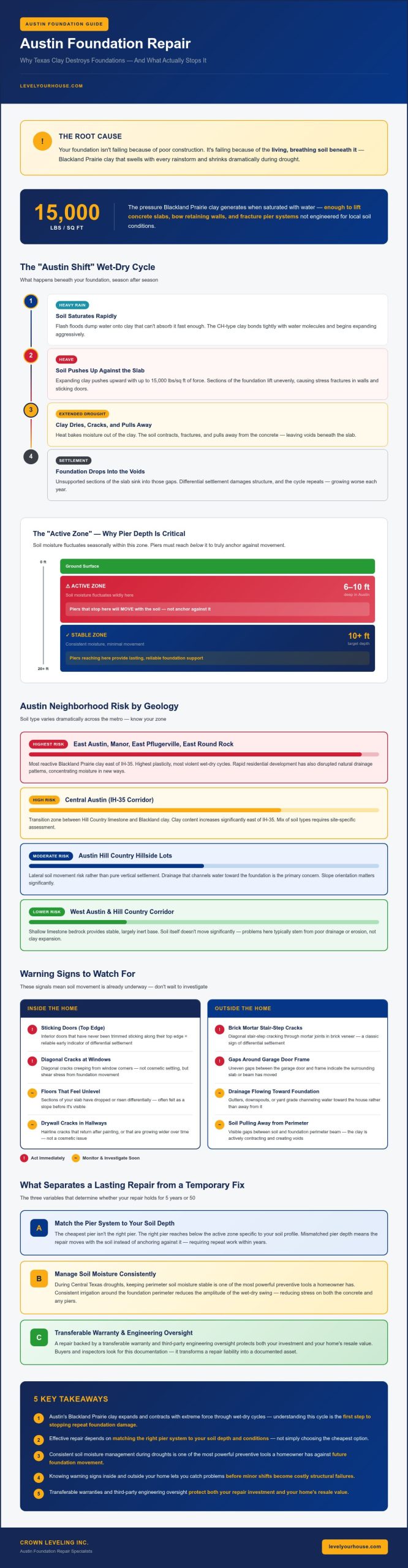
Austin sits on one of the most geologically demanding building surfaces in the entire country. The city straddles the eastern edge of the Blackland Prairie, a belt of high-plasticity clay soil that stretches from the Red River down through Central Texas. This isn’t ordinary clay. It absorbs water aggressively, expands with tremendous force, and then shrinks and fractures as it dries. Your foundation sits in the middle of that cycle, year after year.
The pressure this soil generates during expansion can reach up to 15,000 pounds per square foot, according to geotechnical research on expansive clay behavior. That’s enough force to lift concrete slabs, bow retaining walls, and fracture pier systems that weren’t designed with local soil conditions in mind. Understanding this force is the starting point for any serious conversation about foundation repair in Austin.
The Role of Expansive Clay Soil in Foundation Movement
High-plasticity clay soil, classified by engineers as CH-type material, has a molecular structure that bonds tightly with water molecules. When rain saturates the ground, the clay expands, pushing upward against your slab in a process called heave. When drought pulls moisture out, the soil contracts and pulls away from the concrete, leaving voids beneath the slab. Settlement follows as unsupported sections of the foundation drop into those gaps.
In Central Texas, this cycle doesn’t happen slowly. A single flash flood event can saturate soil that has been bone-dry for months, triggering rapid heave across an entire slab within days. The active zone, the depth at which soil moisture fluctuates seasonally, typically extends six to ten feet below grade in the Austin area. Piers that don’t reach below this zone will move with the soil rather than anchoring against it, which is why pier depth matters as much as pier type.
Austin’s 2026 climate pattern has made this worse. Extended heat events bake the clay to extreme dryness, then intense, short-duration storms dump large volumes of water onto soil that can’t absorb it fast enough. The result is a more violent swing between wet and dry states than gradual seasonal change, and foundations bear the full stress of that volatility.
Austin’s Topography: From Hill Country Limestone to East Austin Clay
Not every Austin neighborhood faces the same risk. West Austin and the Hill Country corridor sit on shallow limestone bedrock, which provides a stable, largely inert base for foundations. Homes there can still experience problems from poor drainage or erosion, but the soil itself doesn’t move the way Blackland clay does.
East Austin is a different story. The clay content increases significantly east of IH-35, where the Blackland Prairie geology is most pronounced. Homes in East Austin, Manor, and the eastern portions of Pflugerville and Round Rock sit on some of the most reactive soils in the region. Round Rock and Pflugerville homeowners face an added challenge: rapid residential development over the past decade has disturbed natural drainage patterns, concentrating moisture in areas that previously drained freely.
Slope also matters. Homes built on hillside lots in the Austin Hill Country may face lateral soil movement rather than pure vertical settlement, particularly when drainage channels water toward the foundation rather than away from it. Effective foundation repair in Austin requires accounting for all of these variables, not just the condition of the concrete itself.
Identifying Foundation Trouble: Warning Signs for Austin Homeowners
Most foundation problems announce themselves gradually, through symptoms that are easy to dismiss as ordinary house settling. A door that sticks in July might seem like a humidity issue. A hairline crack in the hallway drywall gets painted over and forgotten. But in Central Texas, these small signals often point to soil movement that’s already underway, and waiting tends to make the repair more involved, not less.
Knowing what to look for, and what it actually means, puts you in a far stronger position than calling a contractor based on a single crack photo.
Interior Warning Signs
Start inside the home. Doors that stick along their top edge, particularly interior doors that have never been trimmed, are a reliable early indicator of differential settlement. When one section of a slab drops while another stays level, the door frame racks out of square. Windows that no longer latch properly follow the same logic: the frame has shifted enough that the hardware no longer aligns.
Sloping floors are harder to spot visually but easy to confirm. A two-foot level placed at the center of a room will show a gap beneath it if the floor has tilted more than a quarter inch over that span. Anything beyond three-quarters of an inch across a ten-foot run is worth documenting and discussing with a structural professional.
Exterior Warning Signs
Outside, focus on the brickwork. Stair-step cracks, diagonal fractures that follow the mortar joints in a staircase pattern, indicate that one section of the foundation has moved relative to an adjacent section. These aren’t cosmetic. They’re the brick veneer telegraphing what the slab below is doing.
Check the garage door opening as well. A gap that’s wider at one corner than the other, or a door that drags on one side, reflects the same differential movement. Also examine the perimeter of the slab where it meets the soil. A visible gap between the concrete edge and the ground, sometimes called a chimney gap, is a specific red flag for Austin slab foundations. It indicates the soil has contracted and pulled away from the foundation, leaving the slab edge unsupported and vulnerable to cracking under load.
Visual Inspection Checklist for Central Texas Homes
Walk through this five-point check before calling anyone:
- Doors and windows: Test every exterior door and window for binding, misalignment, or gaps at the frame corners.
- Floor slope: Use a four-foot level in multiple rooms, especially near the center of the home and along exterior walls.
- Drywall cracks: Note the angle and location. Diagonal cracks running from the corners of door frames or windows suggest structural movement. Horizontal cracks along ceiling-to-wall joints often indicate heave from below.
- Brick and mortar: Look for stair-step cracking, separated mortar joints, or sections of brick that appear to have shifted outward from the wall plane.
- Slab perimeter: Walk the exterior and look for the chimney gap described above, as well as any visible cracking along the foundation edge itself.
One distinction worth understanding: tension cracks occur when soil pulls away and the foundation drops, creating cracks that are wider at the top than the bottom. Shear cracks show a horizontal displacement, where one side of the crack has moved up or sideways relative to the other. Shear cracking is generally the more serious finding, as it suggests active lateral or differential movement rather than simple settlement.
Not every drywall crack signals a structural problem. Seasonal expansion and contraction of wood framing, nail pops, and minor shrinkage during the first years after construction all produce hairline cracks that have nothing to do with the foundation. The pattern matters more than the crack itself. Isolated, hairline-thin cracks at drywall seams are rarely structural. Multiple cracks radiating from the same corner, or cracks that have grown wider over a period of weeks, deserve closer attention.
Hidden Dangers: When Plumbing Leaks Mimic Foundation Issues
Here’s a scenario that catches many Austin homeowners off guard: a slow leak in a slab-embedded water line saturates the clay soil directly beneath the foundation. That localized moisture causes the clay to expand, lifting a section of the slab from below. The symptoms look exactly like foundation settlement, but the cause is a plumbing failure, not soil movement.
Repairing piers before identifying and fixing that leak would be a costly mistake. The soil will continue to heave regardless of what’s done to the foundation structure. This is why hydrostatic pressure testing of the plumbing system is a critical step before any foundation repair in Austin moves forward. The test pressurizes the drain lines to identify leaks that wouldn’t otherwise be visible. If a leak is found beneath the slab, accessing it often requires tunneling rather than breaking through the floor from above. You can learn more about that process in this detailed guide to foundation tunneling for plumbing.
If you’re seeing localized floor heave in one specific area of the home, particularly near a bathroom or kitchen, get the plumbing tested before assuming the soil is the only factor at play. A qualified foundation professional can help you sequence that evaluation correctly before any repair work begins.
Modern Foundation Repair Methods for Austin Soils
No single repair method works for every Austin foundation. The right choice depends on soil depth, the degree of movement, the foundation type, and what’s actually driving the problem. Understanding how each method works, and where it falls short, keeps you from paying for a solution that doesn’t match your situation.
Pressed Concrete Piers
Pressed concrete piers are the most common repair method used in Austin residential work, and for good reason. Hydraulic equipment drives cylindrical concrete segments into the ground until resistance stops the process. They’re cost-effective, installed quickly with minimal landscaping disruption, and well-suited to the upper clay layers common across Central Texas neighborhoods.
The limitation is depth. In areas where the active soil zone extends deeper, pressed concrete piers may not reach stable ground. If they terminate within the zone of seasonal moisture fluctuation, they’ll move with the soil rather than anchor against it, which defeats the purpose of the repair entirely.
Steel Piers
Steel piers solve the depth problem. Hydraulic rams drive steel pipe segments down to what engineers call the “point of refusal,” the depth at which the soil or bedrock resists further penetration. In East Austin’s deep clay profiles, that can mean reaching well past the active zone to genuinely stable material. Steel piers cost more than pressed concrete, but for homes with significant differential settlement or deep reactive soils, they’re often the more durable long-term investment.
Piers vs. Polyurethane: Which is Right for You?
Piers are structural. They physically lift and support a foundation that has lost contact with stable soil below. Polyurethane foam injection works differently: it fills voids beneath a slab and stabilizes the soil in place, but it doesn’t provide the same load-bearing support as a pier system. That distinction matters enormously when choosing between them.
For driveways, pool decks, sidewalks, and garage slabs experiencing minor settling, polyurethane foam foundation repair is often the smarter call. It’s minimally invasive, cures within minutes, and avoids the excavation that pier installation requires. For a home’s primary structural slab showing measurable differential movement, piers are the appropriate tool. Using polyurethane where piers are needed is a short-term patch on a long-term structural problem.
House Leveling for Pier and Beam Foundations
Older Austin homes, particularly those built before the 1960s in neighborhoods like Hyde Park, Bouldin Creek, and Travis Heights, often sit on pier and beam foundations rather than concrete slabs. These systems present their own set of challenges. Wood sills rot from moisture exposure, original piers settle unevenly, and floor joists sag over decades of use.
Leveling a pier and beam home involves replacing deteriorated wood components, installing new concrete or steel support piers, and shimming joists back to level. It’s detailed, hands-on work that requires understanding how load distributes across an older structural system. The house leveling in Texas process for these homes can also restore floor stiffness and eliminate the soft spots that are a hallmark of aging pier and beam construction.
Across all of these methods, one principle holds: effective foundation repair in Austin starts with a custom engineering assessment, not a one-size-fits-all solution. Austin’s terrain shifts from limestone to deep clay within a few miles. A repair plan that ignores that variability is guessing, not engineering.
Preventive Maintenance: Protecting Your Foundation from Texas Droughts
Repairing a foundation addresses what’s already gone wrong. Preventing the next failure is a different discipline entirely, and in Central Texas, it comes down to one variable above all others: consistent soil moisture. The Blackland clay beneath your home doesn’t care whether it’s expanding or contracting; it simply responds to whatever moisture is available. Your job is to keep that moisture level as stable as possible between rainfall events.
The Science of Foundation Watering
Central Texas summers drive a process called evapotranspiration, where heat pulls moisture simultaneously from the soil surface and from vegetation. During an Austin heat event, this process can remove significant moisture from the upper soil layers within days, not weeks. That rapid drying is what triggers the shrink-crack-heave cycle that makes foundation repair in Austin such a recurring issue for homeowners who don’t actively manage their soil.
A simple way to check whether your soil has dried past the danger threshold is the finger test: press two fingers about two inches into the soil along your foundation perimeter. If the soil is powdery, cracked, or pulls away from your finger without any resistance, it’s too dry and your foundation edge is likely losing support. You’re aiming for soil that feels firm but yields slightly, like a wrung-out sponge.
Over-watering is a real risk. Saturating the soil creates localized mud pockets beneath the slab, which can cause upward heave just as damaging as drought-related settlement. The goal isn’t wet soil; it’s consistent soil.
The practical solution is a drip or soaker hose system installed six to twelve inches from the foundation perimeter. Running it on a timer for thirty to forty-five minutes every two to three days during dry periods, rather than long infrequent sessions, mimics the gradual moisture absorption the soil handles best. Adjust frequency based on rainfall and temperature, cutting back immediately after any significant rain event.
Gutters and downspouts are equally important, though they work in the opposite direction. Clogged or poorly directed gutters dump concentrated roof runoff directly against the foundation, creating the rapid saturation that causes heave. Downspout extensions should discharge water at least four to six feet from the slab edge, and the grade around your home should slope away from the foundation to keep that water moving.
Root Barriers and Landscaping Management
Austin’s beloved live oaks are a serious threat to foundation stability. A mature live oak can extract hundreds of gallons of water from the soil daily during summer, and its root system extends well beyond the tree’s canopy. Roots growing beneath a slab draw moisture directly from the clay underneath, causing localized drying and differential settlement that looks identical to drought damage but persists even when you’re watering consistently.
Root barrier installation addresses this by placing a vertical physical barrier in the soil between the tree and the foundation. The barrier redirects root growth downward rather than laterally, protecting the moisture zone beneath the slab without harming the tree itself.
For new plantings, the general guidance for Austin yards is to keep large canopy trees, including oaks, pecans, and elms, at least fifteen to twenty feet from the foundation edge. Smaller ornamental trees and large shrubs should stay at least eight to ten feet away. The closer the planting, the greater the moisture competition in exactly the zone your foundation depends on.
To ensure your trees are not compromising your home’s stability, We Love Trees offers professional assessments and arborist services tailored to the unique soil conditions of the region.
Preventive maintenance won’t eliminate every risk, but it dramatically reduces the frequency and severity of movement events. If you’re unsure whether your current landscaping or drainage setup is putting your foundation at risk, schedule a foundation assessment with Level Your House before the next drought season compounds the problem.
Choosing the Right Foundation Repair Partner in Austin
The Austin foundation repair market is crowded, and not every contractor operates with the same standards. Choosing the wrong partner doesn’t just waste money; it can leave your home with a repair that fails within a few years because it was designed for generic soil conditions rather than the specific clay profile beneath your property.
Start with warranties. A transferable lifetime warranty matters in Austin’s resale market because it moves with the home, not the original owner. When you sell, that warranty becomes a documented assurance to the buyer that the structural work was done to a standard the company stands behind indefinitely. Contractors who offer only short-term or non-transferable coverage are essentially signaling how much confidence they have in their own work.
Third-party engineering reports are equally non-negotiable for any significant repair. Austin’s municipal permitting process for foundation work typically requires documentation that the repair plan meets structural standards, and an independent engineer’s report provides that documentation while also protecting you from being sold more work than your situation actually requires. A contractor who discourages engineering oversight should raise immediate concern.
Be wary of high-pressure sales tactics. Door-to-door solicitation after a storm event, “today-only” pricing, and estimates delivered verbally without written documentation are all red flags in this industry. Legitimate foundation repair companies don’t need to manufacture urgency. Your foundation problem existed before they knocked, and it’ll still be there after a second opinion.
Level Your House combines local soil expertise with advanced repair technology across Austin, Round Rock, Pflugerville, and the broader Central Texas region. The approach here is consultative: assess the actual soil conditions, match the repair method to those conditions, and provide documentation that holds up to engineering and resale scrutiny.
What to Ask During Your Foundation Inspection
Before committing to any repair plan, ask the contractor directly: how deep will the piers be installed, and what soil density testing supports that depth recommendation? A credible answer references the active zone depth for your specific location, not a blanket number applied to every job. Ask about cleanup and landscaping restoration after installation, since pier work involves excavation that should be fully remediated when the crew leaves. Request a written, itemized slab foundation repair quote that specifies pier type, count, depth, and warranty terms before any agreement is signed.
Financing and Value: Is Foundation Repair Worth It?
Foundation issues are one of the most common reasons Austin home sales fall through during inspection. Buyers either walk away or negotiate significant price reductions when a foundation problem surfaces without documentation of a completed repair. Addressing the problem proactively, with a transferable warranty attached, typically preserves far more value than the cost of the repair itself.
Don’t wait for a failed sale to force the issue. Schedule a professional assessment with Level Your House and get a clear picture of what your foundation actually needs, before the next drought season or storm cycle makes the decision for you.
Your Foundation, Your Next Step
Austin’s clay soil isn’t going to change, but how you respond to it can make all the difference. Foundation repair in Austin works best when it starts with understanding what’s actually driving the movement beneath your home, whether that’s expansive Blackland clay, a hidden plumbing leak, or tree roots pulling moisture from the soil. Match the right repair to the right cause, stay consistent with soil moisture management between rain events, and choose a contractor who backs their work with a lifetime transferable warranty.
Level Your House brings deep expertise in Central Texas soil conditions, from the reactive clay profiles of East Austin to the limestone transitions in the Hill Country corridor. Whether your home needs pier installation, a root barrier, or a full structural assessment, the goal is always the same: a lasting solution that protects your property’s value for years ahead.
Don’t wait for the next drought cycle to force your hand. Schedule your professional foundation inspection with Level Your House today and get a clear, honest picture of where your foundation stands.
Frequently Asked Questions About Foundation Repair in Austin
How much does foundation repair cost in Austin on average?
Costs vary widely depending on the severity of movement, the repair method required, and how many piers are needed. A modest repair involving a handful of pressed concrete piers will cost considerably less than a full steel pier installation on a home with significant differential settlement across a large slab. Getting two or three written, itemized quotes is the most reliable way to understand what your specific situation will cost.
Be cautious of unusually low estimates. In Austin’s competitive market, rock-bottom pricing often reflects shallower pier depths or materials that don’t account for the active zone depth in your soil profile. The cheapest repair today can become the most expensive repair in five years.
Does homeowners insurance cover foundation repair in Texas?
Standard homeowners insurance policies in Texas typically exclude foundation repair caused by soil movement, which covers the vast majority of Austin foundation problems. Expansive clay, drought-related settlement, and gradual shifting are considered maintenance issues rather than sudden, accidental losses. That exclusion applies even when the damage is severe.
There are narrow exceptions. If a sudden, covered event like a burst pipe directly causes foundation damage, that specific portion of the claim may be covered. Review your policy’s exclusions carefully and ask your insurer directly before assuming coverage exists. Don’t delay repairs while waiting for a coverage determination that’s unlikely to go in your favor.
How long does the average Austin foundation repair take?
Most residential pier installations in Austin are completed in one to two days for typical slab foundations. Larger homes, complex soil conditions, or jobs requiring a high pier count may extend to three days. Pier and beam repairs often take longer because they involve hands-on work inside the crawl space, including replacing deteriorated wood components alongside installing new support piers.
The work itself is relatively fast. What takes longer is the sequence around it: scheduling the engineering assessment, completing any required plumbing testing, pulling permits if required by Austin’s municipal process, and allowing adequate time for the soil to stabilize after the lift before final adjustments are made.
Will foundation repair cause my plumbing to leak?
Lifting a slab that has settled can, in some cases, stress existing plumbing lines that have shifted position over time. This is especially relevant in older Austin homes where cast iron drain lines may already be brittle or partially separated. A reputable contractor will discuss this risk with you before work begins, not after.
The standard precaution is hydrostatic pressure testing of the drain system both before and after the repair. Pre-repair testing identifies any existing leaks so they can be addressed as part of the project. Post-repair testing confirms that the lift didn’t create new stress points. Skipping this step is a false economy that can lead to slab leaks going undetected beneath a newly repaired foundation.
Is it better to repair a foundation before or after selling a house in Austin?
Repairing before listing is almost always the stronger financial decision. Foundation issues flagged during a buyer’s inspection typically result in price negotiations that exceed the actual repair cost, or they cause deals to fall through entirely. A completed repair with a transferable lifetime warranty is a documented asset that gives buyers confidence rather than a reason to walk away.
Selling “as-is” with a known foundation problem does attract buyers, but they’re almost exclusively investors seeking a discount. If your goal is maximum sale price, addressing foundation repair in Austin before listing puts you in a far stronger negotiating position than leaving it for the buyer to factor into their offer.
How often should I water my foundation during an Austin drought?
During extended dry periods, running a soaker or drip hose system for thirty to forty-five minutes every two to three days is a reasonable baseline. The goal isn’t saturating the soil; it’s maintaining consistent moisture so the clay doesn’t dry out and contract beneath the slab edge. Short, frequent watering sessions work better than long, infrequent ones because the clay absorbs moisture gradually.
Adjust based on conditions. After any meaningful rainfall, pause watering entirely until the soil returns to its normal dry-season moisture level. Check the soil manually by pressing two fingers about two inches into the ground near the perimeter. If it crumbles or pulls away cleanly, it’s too dry. If it sticks to your fingers, hold off watering for a day or two.
What is the best type of pier for Austin’s clay soil?
There’s no single best pier for every Austin property. Pressed concrete piers work well in areas where the active soil zone is shallower and stable material is reachable within their installation depth. Steel piers are better suited to East Austin’s deep clay profiles, where the zone of seasonal moisture fluctuation extends further down and piers need to reach genuinely stable ground to anchor effectively.
The right choice depends on a site-specific assessment of your soil depth, the degree of settlement, and your home’s structural load. A contractor who recommends the same pier type for every job regardless of soil conditions isn’t doing a proper evaluation. Ask specifically what soil data supports the depth recommendation you’re being given.
Can I live in my house while the foundation is being repaired?
In most cases, yes. Foundation repair in Austin typically doesn’t require you to vacate the home. Pier installation work happens outside the perimeter of the house, and the lift itself, while noticeable, doesn’t make the home unsafe to occupy during the process. Some homeowners prefer to be away during the actual lifting phase simply because it can cause minor cosmetic cracking in drywall as the structure adjusts.
The exception is pier and beam work that requires extensive access beneath the home, or situations where interior tunneling is needed to address a plumbing issue beneath the slab. In those cases, specific rooms may need to be cleared, but full evacuation is rarely necessary. Your contractor should give you a clear picture of daily access and disruption before work begins.