
The expansive clay soils of Central Texas can exert thousands of pounds of pressure against your foundation, making structural repair in Austin an inevitable reality for many property owners. Whether you live in a historic pier and beam home in Hyde Park or a modern slab in Pflugerville, the seasonal shift of the Blackland Prairie soil doesn’t discriminate. Seeing a staircase crack appear in your brickwork or feeling a bedroom door suddenly stick is enough to make any homeowner worry about the safety of their largest investment.
It’s completely normal to feel overwhelmed by the conflicting advice surrounding piers versus polyurethane foam or the potential costs of maintenance in our growing city. You deserve a stable, level home where the windows glide open and the resale value stays protected. This guide helps you identify and resolve issues within Austin’s unique environment. We’ll preview the 2026 permit process, explain why an independent engineer’s report, which typically costs between $250 and $600, is your best first step, and show you how a comprehensive approach to drainage can prevent future movement. From understanding the $136.45 express residential plan review fee to choosing the right specialized contractor, you’ll gain the clarity needed to protect your home’s future.
Key Takeaways
- Understand how the “Blackland Prairie” clay soil behaves and why it is the leading cause for structural repair in Austin.
- Identify critical warning signs like interior drywall gaps and exterior chimney separation before they lead to catastrophic home failure.
- Evaluate the pros and cons of modern stabilization methods, including deep-driven steel piers and cost-effective pressed pilings.
- Navigate the 2026 repair process by understanding the impact of permit fees, engineering reports, and essential plumbing tests.
- Learn why managing the environment around your foundation with drainage and root barriers is just as important as the repair itself.
Understanding Structural Damage in Austin’s Expansive Clay Soil
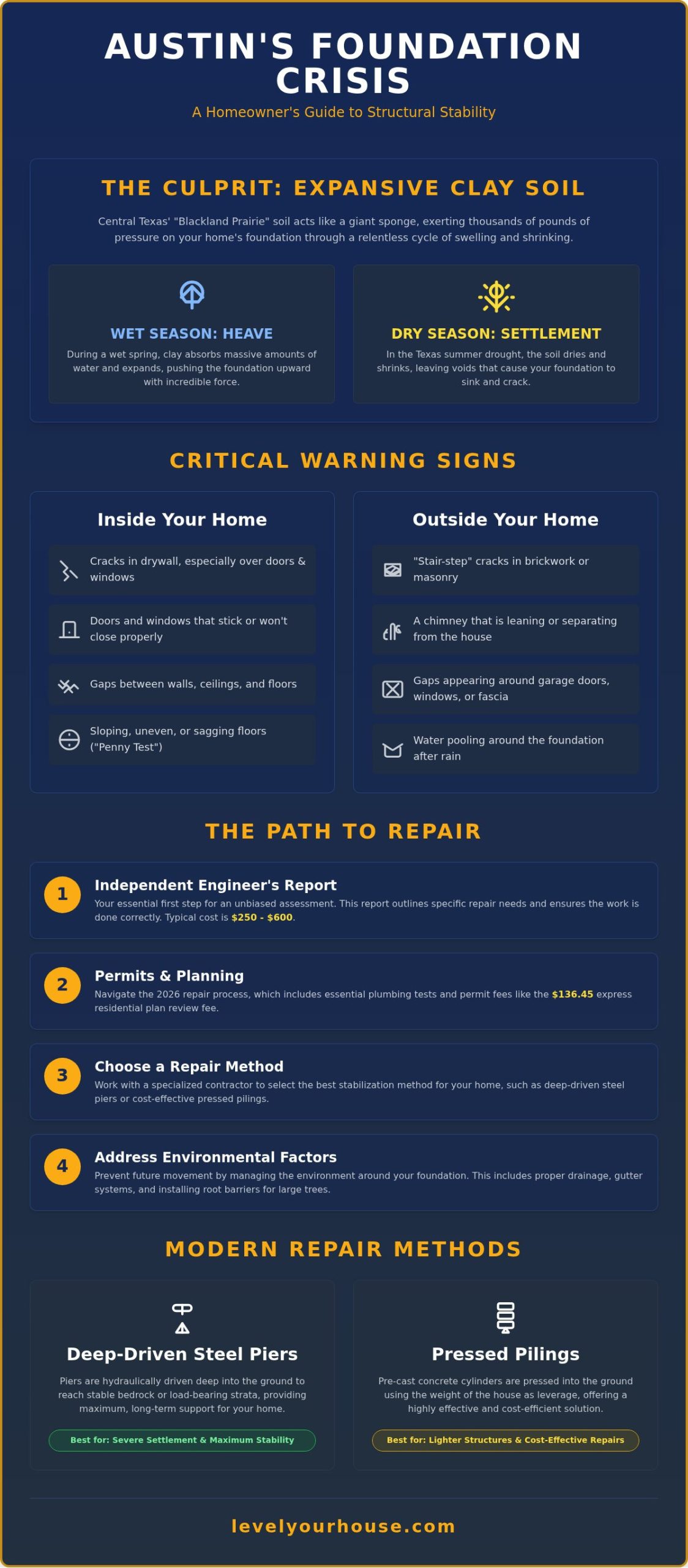
The primary culprit behind most foundation issues in Central Texas is the expansive clay soil found throughout the region. This soil behaves like a giant sponge. During a wet Austin spring, the clay absorbs water and expands, pushing upward with incredible force. When the inevitable Texas summer drought arrives, the soil dries out and shrinks, leaving voids that cause your foundation to sink. This cycle of swelling and shrinking creates a constant state of stress for your home. Unlike stable rocky soils, this “active zone” in Austin can extend several feet deep, meaning your home is essentially sitting on a moving target.
The Science of Soil Heave and Settlement
Soil movement generally falls into two categories: heave and settlement. Heave occurs when moisture causes the soil to swell and push the foundation upward. Settlement happens when the soil dries out and your home sinks into the resulting gaps. Both processes cause uneven pressure on concrete slabs, leading to cracks and structural instability. Many homeowners find that a root barrier installation is their first line of defense. Large trees can suck hundreds of gallons of water from the soil daily, accelerating the drying process and causing localized settlement near the root system.
Austin Neighborhoods Most at Risk
Austin’s geology varies wildly depending on which side of I-35 you call home. West Austin sits primarily on solid limestone, which provides a more stable base but can still suffer from drainage issues. In contrast, East Austin and the Blackland Prairie region are dominated by deep, highly active clay. Older neighborhoods like Hyde Park or South Lamar often face issues with aging pier and beam systems or cast iron pipes that leak and saturate the soil. Meanwhile, newer developments in Pflugerville and Round Rock aren’t immune. Rapid land development can disturb natural drainage patterns, making professional structural repair in Austin a common necessity even for homes built within the last decade.
Warning Signs: When to Call for a Structural Inspection in Central Texas
Identifying early warning signs is the best way to prevent minor settlement from becoming a major structural failure. In Central Texas, indicators are often subtle. You might notice a thin crack in the drywall above a door frame or a floor that feels slightly uneven when you walk across the room. These interior red flags, along with gaps appearing between the wall and the ceiling, are clear signals that your home’s frame is under stress and you may need to consult a specialist for structural repair austin services.
Exterior signs are often more dramatic. Look for “stair-step” cracks following the mortar lines in your brickwork. A separating chimney is another high-priority warning; if you can see a gap between the chimney stack and the rest of the house, the foundation beneath it is likely failing. Functional issues also provide clues. If your front door won’t latch or a window in the guest room is suddenly stuck shut, the house has shifted out of square. For a quick DIY check, try the “Penny Test” on your floors. If a penny can roll on its own across a supposedly flat hardwood or tile surface, you have a slope that requires a professional structural repair austin evaluation.
Differentiating Settlement Cracks from Structural Failure
Not every crack requires a full-scale intervention. Vertical cracks often result from minor settling as a home finds its footing in the soil. However, horizontal cracks or diagonal cracks wider than 1/4 inch suggest significant lateral pressure or vertical displacement. Structural movement is defined as any foundation deflection that exceeds the design tolerance of the building’s materials, leading to functional or safety compromises. Understanding the causes of damage from expansive soils helps determine if you’re looking at a cosmetic blemish or a threat to your home’s integrity.
The Role of Under-Slab Plumbing Leaks
In Austin, especially in homes built before 1980 with cast iron pipes, plumbing leaks are a frequent catalyst for foundation issues. A hidden sewer leak can saturate the soil beneath a specific room, causing that area to “heave” while the rest of the slab remains stable. If you notice a sudden spike in your water bill or a localized soft spot in your flooring, a leak might be the culprit. Resolving this often requires foundation tunneling for plumbing to access and repair the pipes without breaking through your interior floors. If you suspect your home is shifting, scheduling a structural assessment can help you catch these issues before they escalate.
Modern Structural Repair Methods for Austin Properties
Selecting the right method for structural repair in Austin depends entirely on your home’s foundation type and the specific behavior of the soil beneath it. While some properties require deep stabilization to reach bedrock, others might only need surface-level corrections to fix a minor slope. Addressing the root cause is vital; for instance, if a hidden plumbing leak has saturated the clay, the water source must be controlled before any permanent stabilization can occur. Modern technology allows us to address these issues with minimal disruption to your daily life.
Deep-driven steel piers are often considered the gold standard for Central Texas homes. These piers are driven through the expansive clay layers until they reach a stable load-bearing strata, providing a permanent solution that isn’t affected by seasonal moisture changes. For many residential projects, concrete pressed pilings offer a more cost-effective alternative. These use the weight of the house to drive concrete cylinders into the ground, creating a sturdy support system. For Austin’s historic pier and beam homes, adjustments often involve a more hands-on approach, including the replacement of rotted wood and the recalibration of the support jacks to restore a level floor.
Piers vs. Polyurethane: Choosing the Right Solution
Not every structural issue requires heavy drilling. For areas where a concrete slab is intact but has settled due to soil shrinkage or voids, polyurethane foam foundation repair provides a high-precision alternative. This method is particularly effective for lifting sunken patios, driveways, or interior floors that have “dished” in the center. Unlike heavy piers that provide deep support, foam injection fills the empty spaces directly beneath the concrete, hardening quickly to provide a lightweight yet incredibly strong base. It’s a faster process that avoids the heavy excavation required for pier installation, though it’s typically reserved for non-load-bearing leveling rather than deep structural stabilization.
House Leveling and Structural Restoration
Older properties in neighborhoods like South Lamar or Hyde Park frequently require specialized house leveling to correct decades of shifting. This process involves more than just lifting the structure; it’s a careful restoration of the entire support system. We often find that rotted sills or sagging floor joists are contributing to the uneven feel of the home. By replacing these damaged components and ensuring a perfectly level base, we create a stable environment for future interior renovations. It’s essential to complete this structural work before you invest in new tile or cabinetry, as any future movement could easily ruin those expensive cosmetic upgrades.
Navigating the Cost and Process of Austin Structural Repairs
Understanding the financial commitment of structural repair in Austin requires looking beyond a single flat rate. Every home sits on a different pocket of clay, and the depth required to reach stable strata varies from neighborhood to neighborhood. Costs are primarily driven by the number of piers needed and the specific method of installation. For instance, deep-driven steel piers that reach 20 or 30 feet into the ground involve different logistics than concrete pressed pilings. Accessibility also plays a role; if a crew has to hand-dig under a deck or through a narrow side yard, labor hours will increase accordingly.
Beyond the obvious pier costs, you’ll need to account for essential third-party fees and “hidden” requirements. For fiscal year 2026, the City of Austin Development Services Department has set an Express Residential Plan Review fee of $136.45 and a Residential Express Permit fee of $87.49. Most projects also require a report from an independent structural engineer, which typically costs between $250 and $600. These reports aren’t just an extra expense; they’re vital for ensuring the repair plan is sound and for closing out your permits correctly. You should also budget for post-repair plumbing tests to ensure that the process of lifting the home didn’t stress old pipes.
Time is another critical factor. While the actual physical work of a structural repair austin project usually takes between two and five days, the administrative side requires patience. Permit processing times currently range from one to three weeks. Investing in these repairs protects your equity. A home with documented, permitted structural work and a transferable warranty is much easier to sell than one with unaddressed foundation issues or unpermitted “handyman” fixes. If you’re ready to get a clear picture of your home’s needs, request a professional structural evaluation to see how these factors apply to your specific property.
What to Expect During the Repair Process
The road to a stable home follows a specific sequence. It begins with the structural engineering report and a site plan that identifies exactly where each pier will go. Once permits are in hand, the excavation phase starts. This is the loudest part of the process, as crews dig holes around your perimeter and drive the piers into the earth. Finally, the lift and stabilization process begins. This is done slowly and methodically, using hydraulic jacks to bring the foundation back toward its original position while monitoring for interior shifts.
Following these structural fixes, homeowners can proceed with exterior restoration. As noted by specialists at Royalty Construction, ensuring a stable base is the most critical step before investing in significant exterior home improvement or restoration projects.
Questions to Ask Your Structural Repair Contractor
Hiring the right team is about more than just the lowest bid. Use this checklist during your walkthrough to ensure you’re working with a professional who understands local regulations:
- Are you licensed? Every contractor must have a Residential Construction Contractor License from the Texas Department of Licensing and Regulation (TDLR).
- Is the warranty transferable? This is crucial for maintaining your home’s resale value.
- Will an independent engineer verify the results? Professional firms will always have a third-party engineer sign off on the final lift to ensure it meets safety standards.
- How do you handle permit fees? Ensure they’re familiar with the City of Austin’s 2026 fee structure and express permit process.
Why Crown Leveling Inc. is Austin’s Trusted Structural Partner
Our team doesn’t just work in Central Texas; we live here and understand the specific demands of the local landscape. From the rocky limestone ridges of West Austin to the deep, shifting clays of the Blackland Prairie, Crown Leveling Inc. has spent years perfecting the art of structural repair in Austin. Our approach isn’t a one-size-fits-all solution. It’s a diagnostic process that looks at the whole property, including drainage patterns and root systems, to ensure your home stays level for decades rather than just a few seasons. We know the soil from Georgetown to San Marcos, and we use that expertise to build lasting stability.
We prioritize engineering excellence over high-pressure sales tactics. Every project we undertake, from residential slab foundation repair to complex pier and beam adjustments, is guided by data and transparency. We know that structural issues are stressful for any property owner. That’s why we provide clear, upfront pricing and detailed explanations of every recommended fix. Our goal is to be a helpful partner, helping you protect your home’s value and your family’s safety without the stress of aggressive marketing or hidden fees.
Serving the Greater Austin Area
Our expertise extends well beyond the city center. Crown Leveling Inc. provides localized solutions for homeowners in Pflugerville, Round Rock, and Cedar Park, where rapid development often meets challenging soil conditions. In addition to residential work, we offer specialized commercial foundation repair in Austin’s busy business districts. Whether you’re managing a retail space or a multi-family complex, we provide quick response times for emergency structural assessments to keep your operations running safely and minimize downtime for your tenants.
Your Path to a Stable Home Starts Here
Regaining peace of mind about your property is a straightforward process that begins with scheduling a free structural evaluation. During this visit, we don’t just look at surface cracks; we perform a comprehensive levels survey and a thorough visual inspection of your home’s interior and exterior. You’ll receive a detailed report that outlines our findings and, if necessary, a clear plan for structural repair austin that fits your specific needs and budget. Take the first step toward a stable home today by reaching out to our local team and putting an end to the uncertainty of foundation movement.
Secure Your Home’s Foundation for the Future
Your home is likely your most significant investment, and protecting its structural integrity in Central Texas means staying ahead of the shifting clay soils. By identifying early warning signs like stair-step cracks or sticking doors, you can address movement before it requires extensive reconstruction. Whether you choose deep-driven steel piers for permanent stability or modern polyurethane solutions for leveling, the key is a comprehensive approach that manages the environment around your slab. Investing in professional structural repair austin doesn’t just fix a current problem; it secures your property’s resale value and your family’s safety for years to come.
Crown Leveling Inc. specializes in expansive clay soil solutions across Austin, Round Rock, and San Marcos. We offer transferable lifetime warranties to ensure your peace of mind long after the job is done. Don’t let foundation worries linger while the soil continues to shift through the seasons. Schedule Your Free Structural Evaluation with Crown Leveling Inc. Today and get a professional assessment of your property’s specific needs. A stable, level home is within reach.
Frequently Asked Questions
How much does structural repair cost in Austin on average?
The total investment for structural repair austin projects depends on the number of piers required, the depth of the soil, and the accessibility of your property. Every home in Central Texas presents unique challenges that dictate the scope of the work. You should also factor in the independent engineer’s report, which typically costs between $250 and $600, and the City of Austin’s 2026 permit fees for plan reviews and residential permits.
Does homeowners insurance cover structural or foundation repair in Texas?
Most standard Texas homeowners insurance policies don’t cover structural repair unless the damage resulted from a specific covered peril like a fire or a sudden plumbing burst. Gradual movement caused by the expansion and contraction of clay soil is typically considered a maintenance issue and is excluded from coverage. It’s best to review your policy’s “dwelling protection” section or ask your agent if you have a foundation rider or endorsement.
How long does a typical Austin structural repair project take?
A typical project takes between two and five days for the physical labor, though the entire process is longer due to administrative requirements. You should account for the one to three weeks the City of Austin Development Services Department usually takes to process foundation repair permits. Once the crew is on-site, the excavation and pier installation happen quickly, followed by the final lift and stabilization of the structure.
Can I sell my Austin house if it has structural problems?
Yes, you can sell a house with structural issues, but you’re legally required to disclose known defects in the Texas Seller’s Disclosure Notice. Many buyers will struggle to get traditional financing for a home with active movement. Completing the structural repair austin work beforehand, along with obtaining a transferable warranty and an engineer’s sign-off, usually maximizes your resale value and attracts a wider pool of qualified buyers.
What is the difference between foundation repair and structural repair?
Foundation repair specifically targets the concrete slab or the pier and beam system that supports the home. Structural repair is a broader term that includes the foundation but also addresses the home’s skeleton, such as floor joists, load-bearing walls, and roof trusses. If your foundation settles, it often causes structural stress throughout the entire frame, requiring a comprehensive approach to restore the building’s overall integrity and safety.
Will my cracks go away immediately after the house is leveled?
Cracks often close or narrow during the leveling process, but they don’t disappear completely on their own. Lifting the home restores the alignment of the frame, but the physical gaps in drywall or brick mortar will still need professional patching and painting. We usually recommend waiting four to six weeks after the stabilization is complete before starting cosmetic repairs to ensure the house has fully settled into its new position.
How do I know if my foundation issues are caused by a plumbing leak?
You can check for unexplained spikes in your water bill or localized “heave,” where one specific area of the floor feels higher than the rest. In Austin homes built before 1980, deteriorating cast iron pipes are a frequent cause of localized soil saturation. A professional plumber can perform a hydrostatic pressure test to confirm if a leak under the slab is contributing to your home’s structural instability.
Is polyurethane foam a permanent fix for structural issues?
Polyurethane foam is a permanent solution for void filling and lifting concrete surfaces, but it’s not always a substitute for deep structural piers. While the foam itself is incredibly durable and won’t wash away, its effectiveness depends on the stability of the soil beneath it. It’s an excellent choice for leveling patios and driveways, but load-bearing structural issues often require steel piers to reach stable, load-bearing strata.